
A white label LMS can include a branded mobile app, depending on the platform and the features offered by the provider. For schools, training companies, coaches, universities, and businesses, a mobile app can make learning more convenient while keeping the organization’s branding visible across the entire learning experience.Instead of asking learners to open a browser every time they want to study, organizations can provide an app that is designed around their courses, audience, and brand identity.
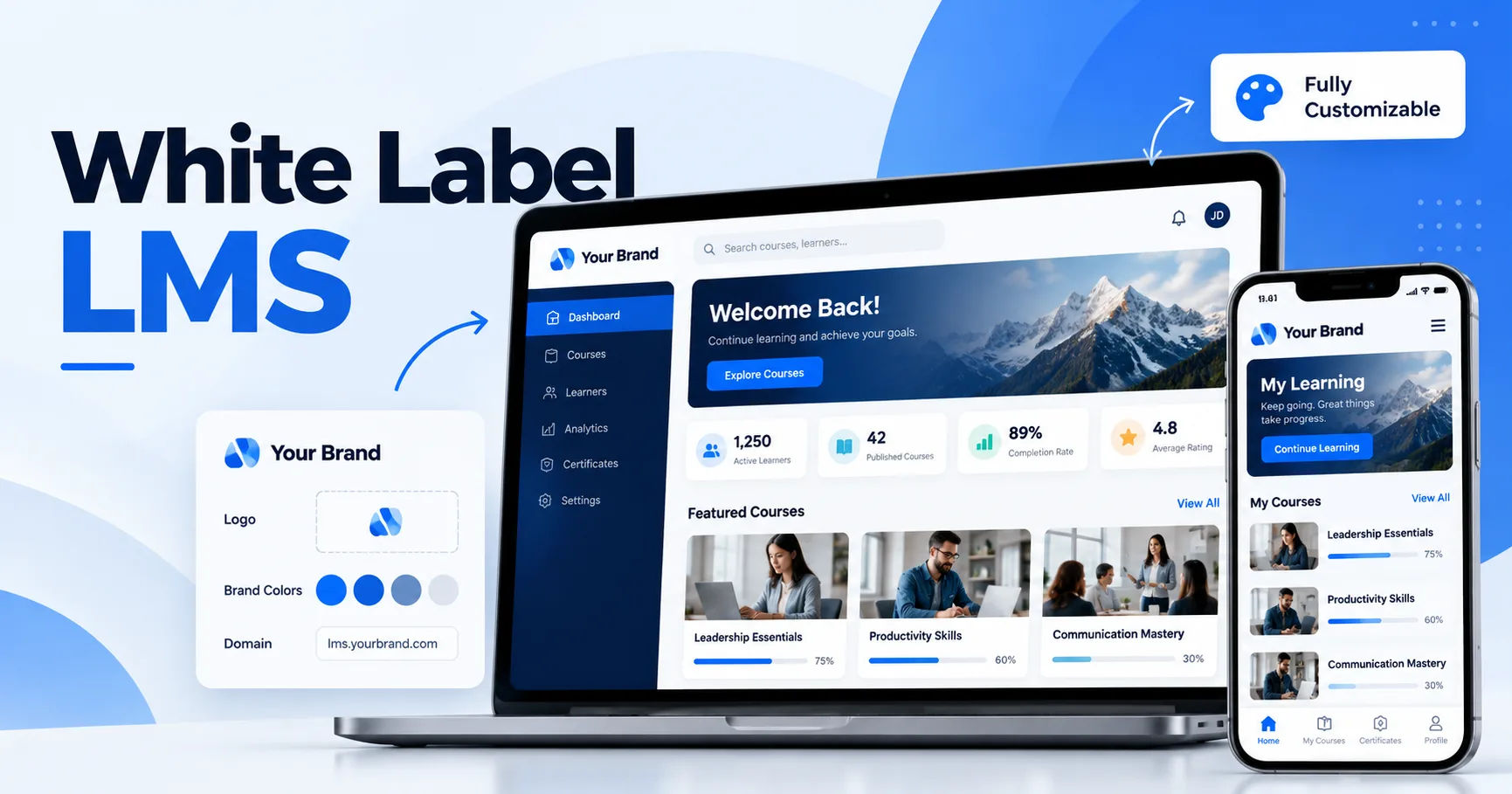
This can create a more consistent experience and make learning easier to access from smartphones and tablets.However, not every white label learning management system provides the same mobile app options. Some offer a ready-made app with basic branding, while others allow businesses to launch a fully customized application under their own name.
Understanding these differences is important before choosing an LMS provider.
What Is a White Label LMS?
A white label LMS is a learning management system that allows an organization to present an existing LMS platform as its own branded learning environment.
The technology is usually developed and maintained by an LMS provider. The customer can then customize elements such as the logo, colors, domain, course interface, and other visual features.
The goal is to create a learning platform that looks like it belongs to the organization rather than an unrelated software company.
For example, a corporate training company could use a white label platform to deliver employee courses under its own brand. Learners may see the company's logo, colors, website address, and course materials throughout the learning experience.
Why Branding Matters in Online Learning
Branding helps learners recognize where their courses are coming from.
A consistent visual identity can also make an online education business appear more professional. When the website, learning portal, emails, and mobile application use the same branding, the entire experience feels more connected.
For organizations selling courses, this consistency can be especially useful because learners interact with the brand throughout their learning journey.
Can a White Label LMS Have a Branded Mobile App?
Yes, a white label LMS can include a branded mobile app, but this depends on the provider's mobile capabilities.
There are several ways an LMS provider may handle mobile access.
Some platforms provide a mobile application that can be customized with the organization's branding. Others provide a responsive website that works well on mobile devices but do not offer a separate app.
More advanced providers may support a dedicated application published under the organization's name in app stores.
This distinction is important. A mobile-friendly LMS and a branded mobile app are not necessarily the same thing.
Mobile-Responsive Website vs. Mobile App
A responsive LMS website automatically adjusts its layout to different screen sizes.
Learners can open it through a mobile browser such as Chrome or Safari. They may still be able to watch videos, complete quizzes, download materials, and track progress.
A mobile app, however, is installed directly on the user's smartphone or tablet.
An app can provide additional features such as push notifications, easier access, offline learning, and a more app-focused user experience.
Therefore, organizations should ask an LMS provider specifically whether it offers a native or dedicated branded mobile application.
What Does a Branded LMS Mobile App Include?
The exact features vary between providers, but a branded app can include many of the same learning functions available through the main LMS.
Custom Logo and Brand Colors
The organization can often use its own logo, colors, fonts, and visual identity.
This makes the application feel connected to the organization's existing website and learning platform.
For example, a professional training company could use its corporate colors throughout the app rather than displaying the LMS provider's branding.
Custom App Name
Some white label solutions allow the mobile application to be published under the customer's brand name.
Instead of learners searching for the LMS provider's application, they may be able to find the organization's own app in the relevant app store.
This can strengthen brand recognition.
Course Access
A branded app should ideally allow learners to access their courses from their mobile devices.
Depending on the platform, users may be able to watch video lessons, read educational material, complete assignments, and take quizzes.
This gives learners greater flexibility because they do not have to be sitting at a computer to continue their studies.
Progress Tracking
Mobile applications can connect with the LMS account so learner progress remains synchronized.
A learner might complete half of a lesson on a desktop computer and continue from a smartphone later.
This type of synchronization is useful for people who move between different devices during the day.
Push Notifications and Learner Engagement
One of the major advantages of a mobile app is the ability to send push notifications.
A learning organization could use notifications to remind learners about upcoming lessons, assignments, live sessions, or important announcements.
For example, a student who has not completed a scheduled lesson could receive a reminder through the app.
Notifications can also be used to announce newly released courses or learning materials.
However, notifications should be used carefully. Too many messages can become distracting and may cause users to disable notifications.
Offline Learning Capabilities
Some branded LMS apps support offline learning.
This allows users to download selected course content while they have an internet connection and access it later without continuous connectivity.
Offline access can be particularly useful for learners who have unreliable internet connections or frequently travel.
The exact offline features depend on the LMS. Some platforms may support downloaded videos, while others may limit offline access to certain types of content.
Organizations should confirm these details before selecting a provider.
Benefits of a Branded Mobile App
Adding a branded mobile application to a white label LMS can provide several practical benefits.
Greater Accessibility
People increasingly use smartphones for education, communication, and professional development.
A mobile app allows learners to access educational content from almost anywhere.
Instead of requiring a laptop or desktop computer, an organization can give users another way to participate in its courses.
Stronger Brand Recognition
A branded application keeps the organization's name visible on the learner's device.
The app icon, name, colors, and interface can reinforce the company's identity.
This can be particularly valuable for businesses that sell online courses because the application becomes another point of contact with customers.
Better Learner Convenience
Mobile learning gives students more flexibility.
A learner could review a lesson during a break, listen to educational content while traveling, or complete a short quiz from a smartphone.
This flexibility can make it easier for people with busy schedules to continue their education.
Direct Communication
Push notifications can provide a direct communication channel between the learning organization and its users.
Important announcements can be delivered without requiring learners to repeatedly check their email or log into a website.
More Professional User Experience
A dedicated application can make a digital learning business feel more established.
When the website, LMS, emails, and app share the same branding, users receive a more consistent experience.
How Does a Branded App Work With the LMS?
The mobile app normally connects to the same backend system that powers the LMS.
When a learner logs into the application, the app retrieves information from their LMS account.
This can include enrolled courses, completed lessons, quiz results, certificates, and other learning information.
When the learner completes an activity through the app, the information can be synchronized with the main LMS.
This means administrators do not necessarily need to manage separate learner databases for the website and mobile application.
One Account Across Multiple Devices
A well-integrated system allows learners to use the same account across devices.
For example, a user could begin a course on a laptop, continue on a tablet, and review material on a smartphone.
The learner's progress should remain connected across these devices when synchronization is properly implemented.
What Should You Ask an LMS Provider?
Before purchasing a white label LMS with mobile capabilities, organizations should ask specific questions.
Is the App Fully Branded?
Some providers only allow a logo or color change.
Others offer deeper customization.
Ask whether the app can use your organization name, logo, colors, icon, and other brand elements.
Is It Published Under Your Brand?
Find out whether the application can appear in the Apple App Store and Google Play under your organization’s name.
This can be an important distinction for companies that want a completely branded experience.
Who Handles App Store Publishing?
App store publishing can involve technical requirements, developer accounts, updates, and compliance processes.
Some LMS providers manage these tasks for customers, while others require the organization to handle them.
Knowing who is responsible can prevent unexpected work later.
How Are App Updates Managed?
Mobile operating systems change over time.
The LMS provider should have a process for maintaining compatibility with newer versions of Android and iOS.
Ask whether app updates are included in the subscription and who handles technical maintenance.
Does the App Support Offline Content?
If offline learning is important for your audience, confirm exactly what users can access without an internet connection.
Do not assume that every mobile LMS supports offline learning.
Is a Branded Mobile App Worth It?
The value of a branded app depends on the organization's audience and business model.
For a training company with hundreds or thousands of mobile learners, an app may provide a useful way to deliver courses and maintain regular engagement.
For a smaller organization with occasional learners, a responsive LMS website may be sufficient.
The decision should therefore be based on actual learner behavior rather than simply having an app because it sounds impressive.
Organizations should consider how often learners use mobile devices, whether push notifications are useful, whether offline access is needed, and how important app-store branding is to the business.
Costs and Pricing Considerations
A branded mobile application may be included in an LMS subscription, but some providers charge additional fees.
Costs can depend on factors such as customization, app-store publishing, maintenance, development, and the number of users.
Before signing a contract, organizations should request a complete pricing breakdown.
It is also useful to ask whether future app updates are included.
A low initial price may become more expensive if important mobile features require additional payments.
Security and Data Protection
Security should be considered alongside branding and design.
A mobile LMS can contain sensitive information such as learner profiles, course records, assessments, and certificates.
Organizations should ask providers about account security, data encryption, authentication, backups, and access controls.
They should also understand how user information is stored and processed.
A branded appearance is valuable, but it should never replace proper security practices.
Conclusion
A white label LMS can include a branded mobile app, and this combination can give organizations a more consistent way to deliver online education across websites and mobile devices.
The key difference is between simply having mobile access and having a genuinely branded application. A responsive website may be enough for some organizations, while others may benefit from a dedicated app with custom branding, push notifications, offline access, synchronized progress, and app-store availability.
Before choosing a platform, organizations should examine the provider's mobile features carefully. Questions about branding, app-store publishing, synchronization, offline learning, security, updates, maintenance, and pricing can help clarify what is actually included.
A mobile application is not automatically necessary for every learning business. Its usefulness depends on the needs of the learners and the organization's delivery model. When mobile learning is an important part of the audience's behavior, a properly integrated branded app can extend the LMS beyond the desktop and make educational content easier to access.
Ultimately, the most important factor is not simply whether an LMS offers an app. Organizations should look at how deeply that app integrates with the learning platform and how effectively it supports the learner experience. A well-designed solution can bring the website, LMS, mobile application, and brand together into one connected learning environment.