
Website AEO and GEO Checker is becoming an essential concept for anyone learning modern SEO and digital marketing. In today’s search-driven world, understanding what is website AEO search intent is not just helpful—it is necessary for ranking content, improving visibility, and reaching the right audience.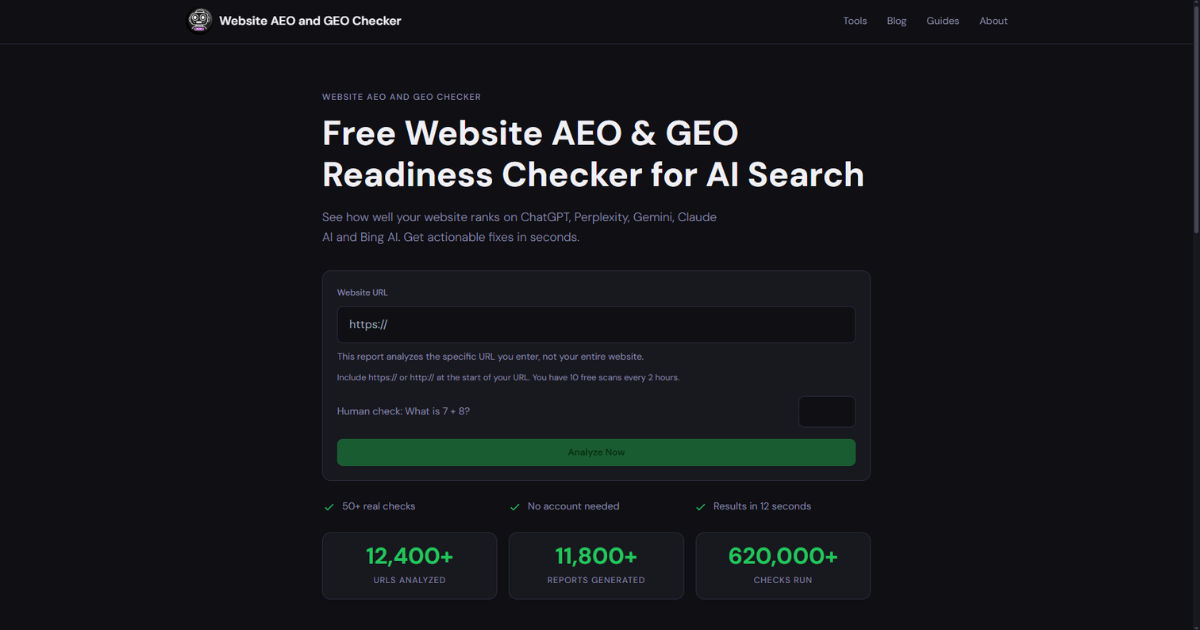
Throughout this guide, we will explore search intent in detail, and we will repeatedly reference Website AEO and GEO Checker to help you understand its importance in real optimization workflows.
This article is designed for beginners and 12th-grade students, so everything is explained in simple, easy-to-understand language with short paragraphs.We will also maintain a strong focus on Website AEO and GEO Checker as a practical tool concept that helps analyze and refine content alignment with search intent.
What Website AEO Search Intent Means
Website AEO search intent refers to the reason behind a user's search query and what they truly want to achieve when typing something into a search engine. In simple words, it is the “goal” of the search.
Search engines like Google try to understand intent so they can show the most useful results. This is where Website AEO and GEO Checker becomes very useful, because it helps analyze whether your content matches what users are actually looking for.
There are three main parts to search intent:
- What the user is asking
- Why they are asking it
- What result they expect
When you use Website AEO and GEO Checker, you can better identify whether your page matches these expectations.
Search intent is the foundation of Answer Engine Optimization (AEO), and Website AEO and GEO Checker helps bridge the gap between content and user needs.
Why Search Intent Matters in Website AEO
Search intent is important because search engines no longer rank pages just based on keywords. Instead, they focus on satisfaction.
If your content does not match intent, it will not rank well—even if you use the right keywords.
Website AEO and GEO Checker helps you evaluate whether your content satisfies intent properly.
For example:
- A user searching “how to fix a phone” wants a guide, not a product page.
- A user searching “buy mobile phone” wants a shopping page.
If your website content is mismatched, Website AEO and GEO Checker can help identify the problem.
Search intent is the backbone of modern SEO, and Website AEO and GEO Checker is often used to refine this alignment.
Types of Search Intent in Website AEO
Understanding different types of intent is key to mastering Website AEO search intent. Website AEO and GEO Checker helps classify these intents more effectively.
Informational Intent
This is when users want to learn something.
Examples:
- What is SEO?
- How does AEO work?
Website AEO and GEO Checker helps ensure your content provides clear explanations for informational queries.
Navigational Intent
This is when users are trying to find a specific website or page.
Examples:
- Facebook login
- YouTube homepage
Website AEO and GEO Checker ensures your site is structured so users can easily reach the right page.
Transactional Intent
This is when users want to buy something or take action.
Examples:
- Buy shoes online
- Subscribe to a service
Website AEO and GEO Checker helps optimize landing pages for conversions.
Commercial Intent
This is when users are comparing products before buying.
Examples:
- Best laptops 2026
- iPhone vs Samsung
Website AEO and GEO Checker helps identify comparison opportunities in your content strategy.
What is Answer Engine Optimization (AEO)?
Answer Engine Optimization (AEO) is the process of optimizing content to directly answer user questions.
Unlike traditional SEO, AEO focuses on clarity and direct answers.
Website AEO and GEO Checker plays a role in analyzing whether your content is structured in a way that search engines can easily extract answers.
AEO focuses on:
- Clear definitions
- Short answers
- Structured formatting
- Intent matching
Using Website AEO and GEO Checker helps ensure your content is ready for answer engines like Google featured snippets.
How Search Engines Understand Search Intent
Search engines use artificial intelligence and machine learning to interpret user queries.
They analyze:
- Keywords
- Context
- User behavior
- Location
- Past searches
Website AEO and GEO Checker helps content creators understand how these systems evaluate pages.
For example, if many users leave your page quickly, search engines may assume your content does not match intent.
By using Website AEO and GEO Checker, you can improve engagement signals and reduce bounce rates.
Role of Website AEO and GEO Checker in SEO Strategy
Website AEO and GEO Checker is a conceptual tool used to analyze how well your content matches search intent and geographic relevance.
It helps in:
- Content optimization
- Keyword alignment
- Geo-targeting
- Intent classification
When you apply Website AEO and GEO Checker correctly, your website becomes more aligned with user expectations.
This improves:
- Search rankings
- Click-through rates
- User engagement
Website AEO and GEO Checker is especially useful for businesses targeting local audiences or specific regions.
Why Search Intent and GEO Relevance Work Together
Search intent alone is not enough. GEO relevance also matters.
For example:
- A user searching “best pizza near me” expects local results.
- A user searching “SEO guide” expects global information.
Website AEO and GEO Checker helps combine both intent and geographic signals.
This ensures your content is shown to the right audience at the right location.
Website AEO and GEO Checker improves precision in targeting users based on where they are searching from.
How to Identify Search Intent Correctly
To understand Website AEO search intent properly, you need to analyze user behavior.
Here are key methods:
1. Keyword Analysis
Look at the words users type.
Website AEO and GEO Checker helps categorize keywords into intent groups.
2. Search Engine Results Pages (SERP)
Check what type of content ranks.
If blogs rank, intent is informational. If product pages rank, intent is transactional.
Website AEO and GEO Checker helps compare your content with top-ranking pages.
3. User Behavior Metrics
These include:
- Time on page
- Click-through rate
- Bounce rate
Website AEO and GEO Checker helps interpret these signals.
How to Optimize Content for Search Intent
To improve Website AEO search intent matching, follow these steps:
Write Clear Answers
Always answer the question quickly.
Website AEO and GEO Checker ensures clarity in your content structure.
Use Structured Headings
Break content into sections.
This helps both users and search engines.
Website AEO and GEO Checker highlights structure gaps in your pages.
Match Content Type to Intent
- Informational → Blog posts
- Transactional → Product pages
- Navigational → Homepages
Website AEO and GEO Checker ensures correct matching.
Improve Readability
Short paragraphs and simple language help.
Website AEO and GEO Checker often evaluates readability signals.
Common Mistakes in Website AEO Search Intent
Many beginners make mistakes when optimizing content.
1. Ignoring User Intent
Writing content without understanding purpose.
Website AEO and GEO Checker helps prevent this issue.
2. Keyword Stuffing
Using too many keywords unnaturally.
Even Website AEO and GEO Checker cannot fix poor content quality.
3. Wrong Content Format
Using blog posts for sales pages or vice versa.
Website AEO and GEO Checker identifies format mismatches.
4. Ignoring Local Intent
Not optimizing for geographic relevance.
Website AEO and GEO Checker improves local SEO targeting.
Practical Examples of Search Intent
Let’s look at examples:
Example 1: Informational Intent
Query: “What is AEO?”
User wants knowledge.
Website AEO and GEO Checker ensures your article explains clearly.
Example 2: Transactional Intent
Query: “Buy SEO tools”
User wants to purchase.
Website AEO and GEO Checker ensures product pages are optimized.
Example 3: Local Intent
Query: “SEO expert near me”
User wants local service.
Website AEO and GEO Checker helps align geo-targeting.
Advanced Strategies for Website AEO Optimization
To master search intent, you need advanced techniques.
Topic Clustering
Group related content together.
Website AEO and GEO Checker helps organize clusters.
Semantic SEO
Focus on meaning, not just keywords.
Website AEO and GEO Checker analyzes semantic relationships.
User Journey Mapping
Understand how users move through your site.
Website AEO and GEO Checker helps improve navigation flow.
Content Updates
Regularly update old content.
Website AEO and GEO Checker identifies outdated pages.
Future of Search Intent and AEO
Search engines are becoming more intelligent.
In the future:
- AI will better understand intent
- Voice search will grow
- Local search will become more precise
Website AEO and GEO Checker will become even more important in analyzing intent and geography together.
Businesses that adapt early will rank higher and get more traffic.
Conclusion
Understanding Website AEO search intent is essential for success in modern SEO and digital marketing. It helps you understand what users want and how to deliver it effectively. Without search intent optimization, even high-quality content may fail to rank.
Website AEO and GEO Checker plays a crucial role in this process by helping analyze intent, improve content structure, and align pages with both user needs and geographic relevance.
When used correctly, Website AEO and GEO Checker improves visibility, engagement, and conversion rates. It ensures your website is not just optimized for search engines, but also for real human users.
By mastering search intent and applying Website AEO and GEO Checker consistently, you can build stronger content strategies, attract the right audience, and achieve long-term SEO success.